Showing posts with label Startup Funding. Show all posts

Thursday, May 7

Ways to Fast Track Your Startup in 2020


 How can you fast track your startup in 2020 – Some tips


· India is emerging as one of the largest startup ecosystems in the world

· India has been recognized across globe for successful startups

· Investors from all over the world are always hunting for Indian Startups as they see a huge growth opportunity here

· Initially Most of the successful startups have faced curveballs


Are you not satisfied with the performance of your startup despite giving your best efforts? Are you still thinking what went wrong in the financial year 2019-2020? Are you looking for some tips to fast track your startup in 2020? Don’t get disheartened and start preparing for the new financial year. The research shows that 20% of the entrepreneurs, who previously failed, succeeded on their next attempt.
The household name Swiggy started its operations with just 6 delivery boys covering a small region near Bengaluru in 2014. And by 2019 it was operational in over 500 cities. 

Flipkart was founded by Sachin and Binny Bansal in 2008 with a mere investment of Rupees 4 Lakhs. It went on to become one of the largest ecommerce startups in India. In August 2018, Walmart acquired a 77% controlling stake in Flipkart for US $16 billion. There are hundreds of success stories in India be it big players like Byju’s, Paytm, or relatively small but successful startups like Country Delight and MilkBasket.


Keep the motivation level always high

You already own the startup and by now must have experienced that it is a laborious task to make it a success. You need to be determined, focused and willing to continue to overcome all the difficulties and challenges that you faced in the last financial year.

Keep the level of motivation among your employees very high. The employees should be as motivated as you are to take the organization to the next level. Only your motivation level, energy and vision for future can help you keep them motivated.

Use of Social Media

Social media is one of the most powerful tools to spread awareness about your brand. You can have a dedicated social media team that can consistently through various SM platforms can spread the achievements and testimonies of your brand. The team needs to make sure that each and every happy client of yours writes a positive review on social media. It is highly likely that an unhappy customer will immediately give you a bad rating. However Most of the he content customers generally do not write reviews. Here the social media team has to take a lead and convince them for good ratings and reviews.  Social media is definitely helpful in creating an overall brand perception.

Analyse and fix the past mistakes

Many entrepreneurs we spoke with emphasized on working on the conversion rates. The leads are enough in the market but the team struggle to get them converted into sales. When we asked them how they overcame this hurdle they told us that in the last financial year their conversion rate was just 5%. The business development team was asked to do only two things to increase the conversion rate. Vigorous should follow-ups and generate more leads. The simple steps worked wonders and the sales increased leaps and bounds in just 3 months.

Research has also proved that the more you follow-up with the clients the chances o getting business is high. Also need to check the target audience and focus on the markets where the demand of your brand or product is high. There’s an old saying, ‘Fish where the fish are’.

Marketing via Blogs and Websites

Make sure that you have a good website/blog that you keep on updating frequently.  Use of SEO is also very important to attract organic traffic to your site or blog.  You can also keep some budget aside for content marketing, content development promotion of your blogs and social media pages. This will definitely give visibility of your startup resulting in more leads for your business and to build your pipeline.

Retain the loyal customers

Make sure that you keep in touch with your clients by asking your team to pay courtesy visits, send souvenir during their anniversaries or birthdays and remind them that they are special to you. If you have sufficient funds you can have your own customer service department to take care of the clients.

SWOT Analysis

 In this day and age the markets are very dynamic, and you need to be abreast with the latest market trends. SWOT analysis at regular intervals is very important for you to stay alive in the cut throat competition. One of the startup owners told us that every Monday they have a meeting and they call it ‘LESSONS LEARNT’. The team discusses the weekly performance and the focus is on the lessons that everybody learnt during the last week. The 7 members of the team when share their lessons learnt, mean all of us has 7 lessons learnt in that particular week.

If you keep some of these points in mind then nobody can stop your startup from reaching new heights. Remember that overnight success is a dream. Only perseverance, strong determination and hard work lead to success. Keep on investing in skills and adapting to new technology. Last financial year what you did was fine but in order to grow and achieve your goals you can’t continue doing the same things.

Monday, May 4

How to Start a New Business in USA: Important Tips

  • Planning to start your own business
  • Looking for some good business ideas
  • Want to know how you can get funding for your Startup
We will show you how you can start your own business in USA if you have any business idea. What are the legalities and the funding options for your business?

Starting a New Business in the USA

First of all you need to decide on which business would be right for you. You do a survey around your region and see what is high on demand now. Make sure that you have understood the business that you are choosing, and it suits your business goals. If you are not sure which business type will suit your plan you can get in touch with The Brand Global Team by writing at connect@thebrandglobal.com. One of our team members will assist you in finalizing your plans. It is better to take advice from the experts when you are a novice in any field.

What Type of Company you are looking for

Once you have the business plan ready then you need to decide which type of company you would like to start. In USA you have many options with you. Some of the popular choices are:

LLC - Limited Liability Corporation

LLC is the most common business type in the USA. The US laws protects your assets in case you face business debts and lawsuits. No big hassles as far as taxation structure are concerned. If you expect that revenue of your business will be small then you can go for LLC. Both residents and non-residents can start an LLC.

C-Corporation

If you are a non-resident and want to start your Business in USA then C-Corporation is recommended for you. Moreover if you want investors to fund your venture and you wish to have shares of your company then you can start a C-Corporation. If you are US residents then you can go for S-Corporation

S-Corporation

With S-Corporation you will have certain advantages as it is only meant for US Residents. Here you are exempt from double taxation. If you think you will make a good revenue then this is the best choice for you as you can save more taxes

Sole Proprietorship

In a Sole Proprietorship, no formal filings are required and it is simplest of all the forms of businesses. However the disadvantage is that in a sole proprietorship, you will have to take personal liability for all business matters. Your business assets and liabilities are not separate from your personal assets and liabilities. If you face debt situation or a loss then you have to compensate that with your personal assets.

Financing your Business

In the USA there are numerous government backed loans and funding programmes for your business. There are government guaranteed loans, financial assistance and grants to start your business.

Some of the options are:

Small Busines Loans – There are many types of loans that you can apply for starting your company or business in USA.

Government Funding Options - There are funding programmes like Small Business Investment Company Programme, Small Business Innovation Research Programme etc. for funding of new Businesses.

Look for the genuine crowd funding sites where you can request to raise funds for your start-up project.

Laws & Tax Requirements for your Business

When you are in a business it is very important that your business is complying with federal, state, and local tax laws.

You need to ensure that all the federal tax requirements for starting a business are met. For more details you can get the information from this official link of US Government

checklist from the IRS.

Apart from complying with all the US laws you also need to ensure that you also follow the consumer protection laws marketing. While hiring the employees for your business keep in mind that here also you need to comply with federal and state regulations.

You can hire only those Foreigners who have permission from the Government to work in USA. It is better to register your company with online E-Verify system. Here is the link where you can register

https://www.e-verify.gov/


Above all you need to secure your new Business by taking a right insurance coverage

How to Start a Business in UAE – A Guide for Beginners

Planning to Start a New Business in Dubai?

Cryptocurrency Exchange Bitex Launched in the UAE
Are you thinking or planning to start your own business in the UAE. Are you looking for some good business ideas? Want to know how you can get funding for your Startup. Remember that reaching a goal without a plan is difficult.

We will show you how you can start your own business in the UAE if you have any business idea. What are the legalities and the funding options for your business?

The UAE is one of the fast-growing economies in the world. The ease of doing business and economic growth is attracting a number of businesses to the country. More importantly, company formation in Dubai takes just two to three weeks and the process is very simple, with strong incentives, notably in the form of the UAE’s free zones.

Starting a New Business

First of all, you need to decide which business would be right for you. You do a survey around your region and see what is high on demand now.
Make sure that you have understood the business that you are choosing, and it suits your business goals. If you are not sure which business type will suit your plan you can get in touch with The Brand Global Team by writing at connect@thebrandglobal.com. One of our team members will assist you in finalizing your plans. It is better to take advice from the experts when you are a novice in any field.


Free Zone Company Registration in UAE

You can get registered at the below Free Zones in UAE
  1. DMCC - Dubai Multi Commodity Center,
  2. JAFZA - (Jabel Ali Free Zone) 
  3. DAFZA - Most convenient for aviation logistics, located next to Dubai Airport
  4. Dubai South - All types of trading and services license with flexi desk options
  5. DSO - Dubai Silicon Oasis, Affordable setup for technology and industrial licensing
  6. Fujairah Free Zone
  7. Ajman Media City
  8. SAIF - Sharjah Airport Free Zone
  9. RAKEZ – RAK FREE ZONE
We are briefly explaining the process of DMCC that you can follow

What is DMCC 

DMCC (Dubai Multi Commodities Centre) was established in 2002 by the Government of Dubai, to provide the physical, market and financial infrastructure required to establish a hub for global commodities trade.


Business in UAE
Image courtesy DMCC
The DMCC Authority in Dubai was offering two types of licenses Until January 2014, DMCC and JLT.

There were DMCC Free Zone companies which were operating in the commodities and related sectors. And then there were JLT Free Zone companies operating across non-commodities related sectors.

However, From February 2014, the authority has decided to licenses all activities under the one DMCC license.

You can fill in the form online at the official website of DMCC

https://www.dmcc.ae/free-zone/application-form

You will find over 600 business activities at the DMCC. You can start the businesses across 20 sectors that include Energy, Commodities, Gold and Diamonds, Technology, Construction, FMCG, Healthcare, Aviation, Shipping, Education and Media, as well as services such as Professional, Financial, Personal and Community.

You can set up your company in just two to three weeks after submitting the necessary documents online. In the interest of maintaining DMCC Free Zone has a very good reputation as the place for good business. Therefore to make sure your business is genuine; the DMCC will conduct due diligence reviews as part of all company setup procedures.

You also need to open your Business account and get your business and employees insured.
Above all you need to get your UAE ID, trade license, Visa and DHA requirements to finalise your residency for you and your employees.

VAT is mandatory by the UAE government now. Get all the documentation done before you start your business.


Make sure that you have hired the best talent for your business. At the same time get the office, website and social media platforms ready before you go live.

Be determined, work hard and think ahead with a positive mindset.

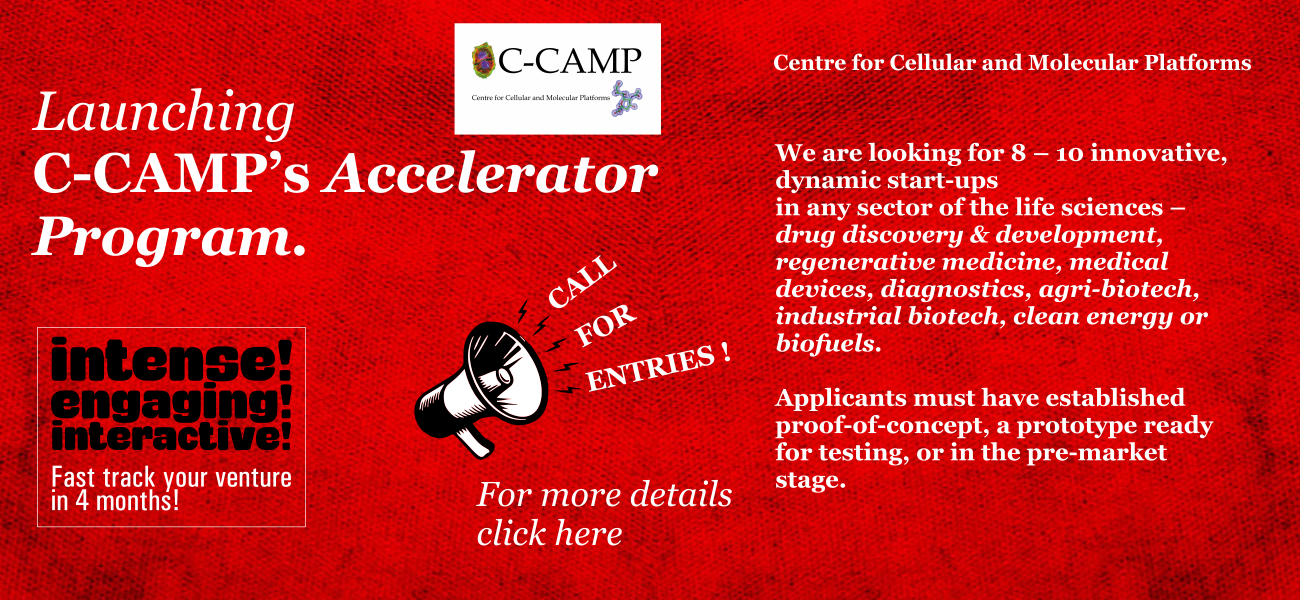
C-CAMP is inviting applicants who can help fight COVID-19 with their Innovations

Cellular and Molecular Platforms (C-CAMP), is a special COVID-19 focused accelerator set up in collaboration with the United Nations Health Innovation Exchange (UNHIE) and Social Alpha. Amid Covid-19 pandemic, the C-CAMP is inviting Startups, innovators, and entrepreneurs who can help fight the pandemic. The Special Covid focused accelerator is also called “COVID-19 Innovations Deployment Accelerator” (CIDA)

Categories for Innovations

The innovations from the players should be under the categories of diagnostics, vaccines, screening, containment strategies, therapeutics, public health & other categories including but not limited to focused technologies. The following is the detailed list of categories:
  • mobile health technologies for screening and home care,
  • protective gear and sterilization innovations for care providers,
  • digital triaging tools and risk stratifying systems,
  • supply chain innovations,
  • AI systems to assist critical care,
  • low-cost ventilators and oxygen therapy units,
  • diagnostic kits and Point of Care tests,
  • volunteerism and service innovations and
  • scalable plug and play isolation units, treatment tents

C-CAMP Accelerator has shortlisted four promising Innovations to deal with Covid-19

In an overwhelming response, C-CAMP has received over 150 submissions so far. As on March 29, 2020, the Pune based centre has already shortlisted four innovations. They are looking for innovations that are ready to deploy immediately and the ones which can also be used for the future.
According to a statement, the C-CAMP has set no specific last date to submit the applications. The received applications are being assessed daily in batches for scientific validity, market readiness, feasibility and impact. Certainly, the new innovations will help India fight the Coronavirus. Furthermore, the innovators will also get a platform to attract investors in the future.

With more than 1000+ positive cases in India, it becomes imperative for India to deploy out-of-the-box innovations to control the spread of Coronavirus. Therefore C-CAMP has come up with this idea of inviting innovations.
By assessing the innovations submitted by the innovators, CIDA will assist in fast-tracking the best and effective innovations for pilot scale deployment. Certainly, it will also help in facilitating regulatory pathway and assist in connecting with the investors.
“Few key players from industry are in constant touch with C-CAMP to support COVID-19 Innovations. CIDA is a step in that direction to help with immediate deployment of solutions wherever we can,” Dr Taslimarif Saiyed, C-CAMP CEO and Director

How to Submit your Innovation to C-CAMP Accelerator

If you are a Startup, innovator, or an entrepreneur who can help fight the Pandemic submit your entry here.

C-CAMP is a major Platform Technology, Industry-Interaction, Innovation and Incubator unit. Considering the vacuum that is present at the interface of Academia and Industry, such an organization is much needed in the country to be able to assure the success of scientific talent.

Investment by Venture Capital in African Startups

African startups are on an upward fundraising trend in 2020 and global investors are taking note of it. Last year the amount of venture capital channelled into African opportunities surpassed the $725.6M raised in 2018 by nearly $500M.

Global Investors in African Startups

There were over ninety African companies that raised over a million dollars each in 2019, with Nigerian companies attracting the lion’s share of over $650 million.

As these African start-ups mature, traditional players such as Goldman Sachs are investing, and large corporate venture arms and sovereign wealth funds are also beginning to circle. Twiga Foods, a Kenya-based food logistics startup, closed a $23.7 million Series B round led by Goldman Sachs, while Goldman also led a $20 million Series A funding round for Nigeria-based freight logistics company Kobo360. Both investments plan to support pan-African expansion.

The entrance of established players signals the growing maturity of Africa’s startup ecosystem as African companies are not only attracting global capital but require the sizable investments these investors desire.
As it did in India, Corporate venture capital (CVC) is also playing a key role in supporting the emerging startup ecosystem in African countries. There is a difference between a traditional VC or PE firm and a Corporate Venture Capital (CVC). The startups have an advantage from CVC funding. Because Unlike conventional VCs, Corporate venture capital gives more time to repay. As a result, the startups get more time to scale post-investment.

One of the bigger names in CVC, Visa has announced that it will buy a 20% stake in Nigerian firm Interswitch for $200 million.

GV also know as Google ventures and Toyota’s venture arm is also planning to invest African companies. Yamaha has shown interest in Nigerian motorcycle transit startup MAX.ng.

Furthermore the big corporate like Mastercard and Shell are also investing in African startups.

Asian Investments in African Startups

2019 also saw Asian entities entering into the African Startup ecosystem. Softbank one of the most prominent players in Asia participated in a $1.25 billion round of fundraising for Airtel-Africa. The telecom company Airtel-Africa is a subsidiary of Airtel India.
Opay, a mobile payments startup in Africa, owned by Chinese investor also raised $50 million in a Series A round from investors including Sequoia China.

Mobile phone device creator, Transsion, which operates in Africa and is owned by China, partnered with Kenya’s Wapi Capital to fund early-stage African fintech startups.

Apart from CVC and VCs, some sovereign wealth funds are also keen on investing in the African market. Abu Dhabi’s state fund is planning to invest $250 million through two funds focused on technology start-ups in the Middle East and North Africa.

Moreover, Qatar Investment Authority has also invested $200 million in the Airtel India subsidiary, Airtel-Africa

The African market has already seen a huge jump in fundraising from the established players giving a very positive sign for African. Jack Ma of Alibaba and Jack Dorsey of Twitter have recently visited the African countries. This has created a buzz among the African ecosystem as they are anticipating more investments in the coming years.


Africa is expecting more and more global investors and bigger players to invest in their companies. The ecosystem is expecting that the negative narrative that African companies are too risky for mainstream venture capital is changing now.

Indian Agritech Startup DeHaat Raises $12M

Green Agrevolution Pvt. Ltd, which operates agricultural technology startup DeHaat, has raised $12 million (around Rs 90.75 crore) in a Series A funding round.

Sequoia Capital India led the funding round, where the Dutch development bank FMO, also contributed. Omnivore and AgFunder, the existing investors, also participated in this round, a company statement said.
DeHaat is one of the fastest-growing startups in the Agri Tech sector. It offers end-to-end solutions and services to the farming community in India.

The company is also building AI-enabled technologies to revolutionize supply chain and production efficiency in the farm sector.

The Gurugram and Patna based company, presently has over 165,000 farmers in their service network. It aims to bring it to 5 million farmers by 2024.

Future Plans of DeHaat

Currently, DeHaat is helping thousands of farmers in securing various agri-input products, like seeds and fertilizers. The company also offers a tailored advisory to the farmers on the crop they should sow in a season.

Last year in March, the company raised a $4 million (around Rs 29 crore) in pre-Series A round, led by Omnivore and AgFunder.

"We are excited to partner with Sequoia India and FMO as we drive towards one million farmers on the DeHaat platform” Shashank Kumar, Co-Founder and CEO of DeHaat 

The DeHaat platform is aggregating corn, wheat, rice, fruits, and vegetables from farmers on their network. It is also directly supplying to over 200 commodity bulk buyers, including retail chains, e-commerce players, FMCG giants, and SME food processors.

The company has plans to automate its supply chain and build the next layer of data analytics to drive further supply chain efficiency.

To improve its last-mile delivery, DeHaat, is also planning to open 2,000 rural retail centres. At the same time company has plans to upgrade the farm produce aggregation and to add farmers to its service network.

DeHaat

The alumni from IIT Delhi, IIT Kharagpur, IIM Ahmedabad, and alumni from other top institutes founded DeHaat 8 years ago.

Co Founders of DeHaat - Shashank Kumar, Amrendra Singh, Adarsh Srivastav, Shyam Sundar Singh, and Abhishek Dokania,

The company operating from Patna and Gurgaon is now a fully funded startup with a growth rate of 3-4x annually.


https://agrevolution.in/

Edutech Startup Pariksha Raises Funding from INSEAD Angels and Others

Pariksha, a Pune-based ed-tech startup, has raised funds amid COVID-19 lockdown, in an extension of its pre-Series A round of funding from a group of angel investors. The funding amount remains undisclosed.


The funding round was led by INSEAD Angels, IIT Kanpur Angels, Nikhil Vora and Swati Mehra from Sixth Sense Ventures, Saahil Bhatia from Temasek Holdings India Pvt. Ltd, and Sitanshu Shah from Bain & Company and other angel investors. Their existing investor, Venture Catalysts, also participated in the round.


Pariksha, a vernacular test preparation company, was founded by Karanvir Singh, Utkarsh Bagri, Vikram Shekhawat, and Deepak Choudhary in 2015. As of now, it operates in 11 states in India, in six languages, and has a subscriber's base of over 65,000.

According to INSEAD Mumbai Angels, this is their first investment.

The group's thesis is to invest in exceptional founders and high growth startups, preferably founded or backed by INSEAD alumni, but we are very impressed with the Pariksha founders' vision, market know-how, execution capabilities and the size of the opportunity - says Akshat Birla from INSEAD

Further, other investors were also upbeat as the market is vast and the growth prospects are very high in this segment. According to Pariksha, over 75 million aspirants in India are spending $2.3 billion on preparing for vernacular state government job exams every year.

Pariksha

Founders - Karanvir Singh, Utkarsh Bagri, Vikram Shekhawat and Deepak Choudhary

Founding Year - 2015

Location - Pune


Website - https://www.pariksha.co/

Sequoia India's Accelerator Programme Surge 03 chose 7 Indian Startups

SEQUOIA India picked 15 early-stage startups from South-east Asia and India for its third Surge Cohort on April 27, 2020. Surge’s third cohort kicked off on April 13 and the 16-week long program will last up to August. Amidst the Covid-19 pandemic, there is a travel ban and other restrictions due to lockdown. And hence it is a complete virtual event and happening remotely via video conferencing.
https://twitter.com/_surgeahead/status/1254614397936254977?s=20
Surge is Sequoia Capital's startup accelerator programme for early-stage startups in India and Southeast Asia. Surge 3 is hosting startups from India, Singapore, Indonesia, and Vietnam.
This time the cohort consists of startups from different domains including software-as-a-service (SaaS), developer tools, consumer internet, fitness, F&B, education, and health among others. Moreover, almost one-third of the startups have at least one female founder.

These startups are Atlan, BukuKas, CoLearn, Convosight, DrinkPrime, Fittr, Hangry, Last9, Pencil, Pentester Academy, Procol, Thuocsi, Togerhall, and Tinvio (with one startup currently in stealth mode).


The seven Indian startups in the third cohort are Atlan, Fittr, DrinkPrime, Procol, Last9, Convosight, and CoLearn.

Meet the Startups selected in Third Surge Cohort

CoLearn

Founders: Abhay Saboo and Marc Irawan
Launched: January 2020
Co-investors: AC Ventures and Alpha JWC Ventures
CoLearn is an ed-tech platform that enables tuition centres and tutors to create online learning experiences for their students.

ConvoSight

Founders: Tamanna Dhamija, Tarun Dhamija, and Kartik Bansal
Launched: October 2019
Co-investor: IvyCap Ventures
Convosight is a community management platform that uses data analytics and machine learning to help admins and brands create, moderate, grow, and leverage communities meaningfully.

DrinkPrime

Founders: Manas Ranjan Hota and Vijender Reddy
Launched: March 2016
Co-investors: Angel investors
DrinkPrime’s mission is to bring clean, affordable drinking water to India, where millions of people cannot access potable water. The startup leverages the internet of things and a seven-stage filtration process to produce clean drinking water from the tap in any consumer’s home.

Procol

Founders: Gaurav Baheti and Sumit Mendiratta
Launched: October 2018
Co-investors: Beenext and Blume Ventures
Procol is a digital procurement platform that helps companies digitize their buying processes for better transparency, traceability, and cost savings.

Last9

Founders: Nishant Modak and Piyush Verma
Launched: January 2020
Co-investors: Better Capital and angel investors
Last9 is a site reliability engineering platform that makes running systems at scale easy. It is currently deployed in closed beta at some of the largest websites in India and Southeast Asia.

Atlan

Founders: Prukalpa Sankar and Varun Banka
Launched: July 2019
Co-investor: Waterbridge Ventures
Atlan is building a home for data teams by bringing together diverse people, tools, and data. It allows various team members to collaborate while using the tools they prefer to work with, such as a business user on Excel, an analyst on SQL, and a team of engineers on Python, making data science significantly more accessible to the organization.

Fittr

Founders: Jitendra Chouksey, Sonal Singh, Jyoti Dabas, Bala Krishna Reddy, and Rohit Chattopadhyay
Launched: March 2019
Co-investor: Better Capital

Fittr is an online fitness app that offers its community free access to diet and training tools provided by fitness experts and enthusiasts.

BukuKas

Founders: Krishnan Menon and Lorenzo Peracchione
Launched: December 2019
Co-investors: Credit Saison, Hustle Fund, Whiteboard Capital, 500 Startups, and angel investors
BukuKas helps owners of Indonesian micro, small, and medium enterprises understand and manage their financial flows more effectively with an easy-to-use digital ledger they can download on their smartphones.

Hangry

Founders: Abraham Viktor, Andreas Resha, and Robin Tan
Launched: November 2019
Co-investor: Alpha JWC Ventures
Hangry is a cloud kitchen that serves up multiple in-house restaurant brands for online orders and delivery. By using a common kitchen with shared staff and resources, Hangry’s asset-light model allows it to produce quality food at affordable prices for Indonesia’s fast-growing, mobile-first population.

Pencil

Founders: Will Hanschell and Sumukh Avadhani
 Launched: May 2019
 Co-investors: SG Innovate, Wavemaker Partners, and an angel investor
Pencil brings the scale of algorithms to the creative process by generating ads that are predicted to work. It is the first generative creative platform for performance advertising teams in brands and agencies.

Pentester Academy

Founder: Vivek Ramachandran
 Launched: March 2019
Pentester Academy trains security professionals on the art and science of defeating hackers and making the internet safer. It does this by replacing theory classes with practical experiences that are both fun and edifying.

Thuocsi

Founders: Nguyen Huu Minh Hoang, Nguyen Xuan Hiep, and Vuong Dinh Vu
Launched: November 2017
Co-investors: Cocoon Capital and Genesia Ventures
Thuocsi is an online business-to-business marketplace for pharmaceutical, health, and personal care needs. It was launched in Ho Chi Minh City in 2018 by Singapore-based health tech firm BuyMed to simplify Vietnam’s healthcare distribution process.

Tigerhall

Founder: Nellie Wartoft
Launched: March 2019
Co-investors: Taurus Ventures, XA Network (formerly Xoogler Angel Network), and angel investors
Tigerhall is a mobile learning platform that aims to help professionals achieve their career and life goals by learning directly from Asia’s most successful people.

Tinvio

Founder: Ajay Gopal
Launched: July 2019
Co-investors: Global Founders Capital and Partech Partners
Tinvio is a communication and commerce platform built around the idea that merchants and suppliers should be able to work smarter together.

According to Surge “Eighty per cent of Surge 03 startups are coming onboard with institutional co-investors, and almost half have Angel co-investors, too. Collectively, this cohort has raised over $39 million in their Surge rounds. (What’s more, Surge 01 and 02 startups have already raised USD 250M+ after completing Surge, in subsequent financing rounds).”

Sequoia Capital launched its First Cohort in March 2019 with 17 startups. In the second surge cohort in October 2019, it picked 20 startups.

Sequoia has picked up 15 startups in the third cohort from the community which has grown to over 110 founders with 52 startups based in six countries. Out of the 52 startups, 27 are from India.
Above all, the announcement of 15 startups is good news at this time of the Corona Crisis when the economy is down and startups are uncertain about the future.


The applications for Surge 04 from September 2020 to January 2021 are also open now.